A bad review on Trustpilot costs you nothing. A good one starts at $99 a month.
That single fact explains a lot. The platform whose revenue depends on getting non-paying businesses to subscribe has a built-in reason to let their scores look worse than they need to.
If you’re here, something probably already happened to you: you declined a Trustpilot sales pitch, and shortly after, your account got restricted and your positive reviews disappeared.
It happened to me too. Here’s everything I found when I went looking for proof it wasn’t a coincidence.
Trustpilot Scores: Paying Companies vs. Everyone Else
Let’s state the hypothesis clearly before testing it: businesses that decline Trustpilot’s paid subscriptions see their positive reviews lose visibility, while businesses that pay see their scores improve.
The strongest evidence comes from Grizzly Research’s December 4, 2025 report, “The Trustpilot Mafia.” The firm alleged Trustpilot “creates unsolicited review profiles… with the intention to attract hyper-negative reviews and force these businesses into paying subscription deals,” and that “paid-for profiles see their review score magically lift from under 2 of 5 stars to over 4 of 5 stars.”
It backed this with side-by-side comparisons across industries – U.S. opticians, UK broadband providers, washing machine brands, pharmacies, U.S. gyms – arguing paying profiles scored implausibly higher than non-paying ones and higher than the same companies scored on other review sites entirely (broadband.co.uk, Reviews.io, BBB, WalletHub).
| Brand | Paid Trustpilot Subscription | Average Review Score (number of reviews) | Annual Company Revenue |
|---|---|---|---|
| Eyebuydirect | yes | 4.5 (30,896) | US$ 342M |
| Warby Parker | no | 1.8 (195) | US$ 771M |
| GlassesUSA | yes | 4.4 (114,930) | US$ 242M |
| Target Optical | no | 2.4 (385) | NA |
| Zenni Optical | yes | 4.5 (162,916) | US$ 436M |
| America’s Best Contacts & Eyeglasses | no | 1.9 (214) | US$ 75M |
| SmartBuyGlasses | yes | 4.7 (17,886) | US$ 14M |
Its single most specific data point: Vodafone pays for Trustpilot only in the UK, where it holds 6% market share, and scores well there — while its non-paying profiles in Germany (28% share), Italy (31%), Spain (14%), and the Netherlands (40%) score far lower. Why would Vodafone’s service be excellent in the U.K. but poor in its other markets?
| Brand | Paid Trustpilot Subscription | Average Review Score (number of reviews) | Market Share in Region |
|---|---|---|---|
| Vodafone Deutschland | no | 1.4 (28,116) | 28% |
| Vodafone Italia | no | 1.2 (10,053) | 31% |
| Vodafone España | no | 1.1 (6,250) | 14% |
| Vodafone NL | no | 1.3 (2,742) | 40% |
| Vodafone UK | yes | 4.6 (108,052) | 6% |
It also flagged Freecash.com, which had roughly 249,000 reviews averaging 4.8/5 – higher than Gmail (1.6), Netflix (1.5), or Steam (1.9) – and noted Freecash’s operator employs a former Trustpilot Global Director of Quality & Compliance. On pharmacies, it compared paying subscribers Boots (4.5) and DocMorris (4.6) against non-paying Walgreens (1.5) and CVS (1.6).
Paying businesses score higher, again and again, across industries that have nothing to do with each other. That kind of consistency is exactly what makes the pattern hard to wave away as a coincidence.
What Trustpilot Removes, and What It Doesn’t
Trustpilot says it screens roughly 200,000 reviews submitted per day through automated detection before publication – machine learning, neural networks, and graph-based models analyzing IP addresses, device fingerprints, location data, timestamps, and behavioral patterns, not just review text. In 2024 it added AI/stylometric classifiers to estimate whether a review was written by an LLM. By its own reporting: 2.2 million fake or harmful reviews removed in 2020 (its first transparency report), rising to 4.5 million in 2024 (7.4% of all submissions, 90% caught automatically before publication), and 6.7 million removed in just the first eleven months of 2025 – a 68% year-over-year increase.
Trustpilot has consistently reported that the vast majority of fake reviews it removes are positive ones – because most fake-review fraud is businesses inflating their own scores, not competitors attacking them.
But that isn’t the whole story. When a business disputes a negative review, the reviewer is asked to provide documentation proving they were a genuine customer. However, even when a reviewer never provided documentation within the window, negative reviews on my free accounts were often left up anyway. On the paid accounts, the same kind of undocumented, unresolved flag are far more likely to result in the review actually coming down.
Trustpilot Fined for Fake Reviews
Regulators haven’t ruled on the exact “pay us or lose your good reviews” claim, and they have found real problems – each one lines up with a different piece of the broader complaint.
Italy: Rigged System
Italy’s Competition Authority fined Trustpilot Group Plc, Trustpilot A/S, and Trustpilot S.r.l. €4 million after an investigation opened in mid-2025. This is the finding that comes closest to validating the “the deck is stacked” complaint:
- Trustpilot failed to adequately verify review authenticity, including reviews it labeled “verified.”
- Trustpilot’s review-collection tools let businesses handpick which customers received review invitations – meaning a business can selectively invite only its happiest customers, which the AGCM found undermines how representative the resulting score actually is.
- Trustpilot used “dark pattern” interface designs that obscured which businesses had paid for services and how the platform actually works.
In its own defense, Trustpilot disclosed it took action against 330+ paying businesses in 2025 and terminated 39 paid subscriptions specifically for review-gating or fake-review violations.
Look closer at those numbers, though. By Trustpilot’s own account, roughly 3% of its 1.3 million claimed business profiles pay for a subscription – somewhere in the range of 39,000 paying businesses. Terminating 39 of them for violations is an enforcement rate of roughly one-tenth of one percent.
As a defense against the accusation that paying customers get preferential treatment, a number that small can just as easily be read the opposite way: either paying businesses are remarkably well-behaved, or a company whose revenue depends on those same 39,000 subscriptions has very little incentive to look hard enough to find more violations among the customers actually paying its bills.
United States: How the System Gets Exploited
NextMed is the case that most directly illustrates how a business can weaponize Trustpilot’s own dispute process against genuine customers. The FTC found NextMed suppressed negative reviews by selectively flagging critical ones without valid basis, offered Amazon gift cards to customers who agreed to remove or change negative reviews, and conditioned refunds on review removal – while also posting fake five-star reviews and testimonials, some using before-and-after photos sourced from a Craigslist ad from people who’d never used the product.
LendEDU: The FTC found 111 of 126 reviews on LendEDU’s Trustpilot page were fabricated by employees and their friends and family, all five-star. LendEDU then featured these fake reviews on its own site under headings like “See What Our Customers Have to Say.”
DK Automation: Falsified positive Trustpilot reviews were part of a broader business-opportunity scam complaint.
Sued for Scam, Rated “Excellent”
Despite the fines above, the underlying problem doesn’t look solved – and JustAnswer is the clearest example. It holds a paid Trustpilot subscription, has racked up over 137,000 reviews there, and sits at 4.6 stars – “Excellent” – with new positive reviews rolling in every hour.
It’s also a company that’s been through this exact regulatory process itself: in January 2026, the FTC sued JustAnswer and its CEO directly, alleging the company advertises access for as little as $1-$5 and then quietly enrolls people in recurring monthly subscriptions of $28–$125 they never clearly agreed to. BBB complaints back it up – one customer charged $250 beyond what he’d agreed to, another $368, both discovering it only months later on a bank statement.
The point is what a 4.6-star “Excellent” Trustpilot score, actively growing on a paid account, coexists with: a live federal lawsuit alleging deceptive billing, and a large volume of BBB and Trustpilot reviews themselves describing exactly that. If Trustpilot’s review-integrity system is working as intended, a company facing this level of credible billing complaints shouldn’t be sitting near the top of the scale.
JustAnswer isn’t an outlier. It’s one of five companies we found holding paid Trustpilot subscriptions and “Excellent” scores while facing federal lawsuits, settlements, or a mounting pile of complaints – see the full breakdown here: How Trustpilot Covers Scam Companies
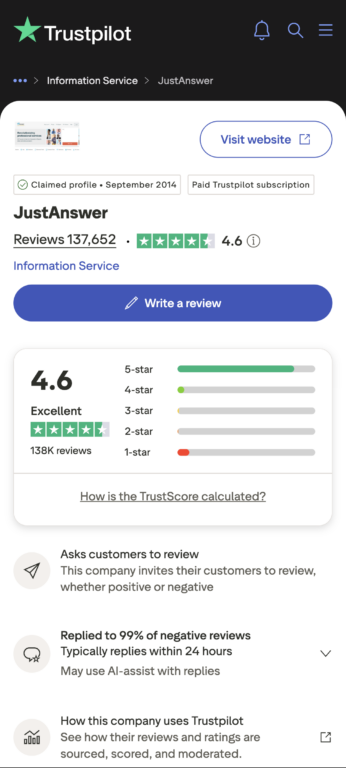
JustAnswer’s Trustpilot profile: 4.6 stars, “Excellent,” 137,652 reviews — on a paid subscription, while facing an active FTC lawsuit over its billing practices
What Happens When You Say No to Trustpilot’s Sales Team
I run several businesses that use Trustpilot, and this is where my own experience fits into everything above.
When I tried to purchase Trustpilot’s Starter plan ($99/month), I wasn’t able to buy it directly. My option to purchase was disabled, and I was contacted by Trustpilot’s sales team, who steered me toward a more expensive package instead.
| Plan | Price | Review invitations/month | Widgets | Users | Domains |
|---|---|---|---|---|---|
| Free | $0/month | 50 | 1 | 1 | 1 |
| Starter | $99/month, billed annually | 100 | 2 | 1 | 1 |
| Plus | $319/month, billed annually | 300 | 10 | 3 | Up to 3 |
| Premium | $799/month, billed annually | 1,000 | 21 | 10 | Unlimited* |
When I declined the upsell and tried to stick with my original plan choice, my account was downgraded to Minimum – the most restrictive tier short of outright account deletion.
Shortly after the downgrade, the positive reviews my business had accumulated stopped being displayed. The negative reviews we had stayed exactly where they were.
I’ve spoken with other business owners who describe similar experiences, and this lines up with a broader pattern of BBB complaints against Trustpilot – including one 2026 complaint describing 11 reviews removed as “fake or suspicious” via a notice that “does not identify any of the 11 reviews that were removed.”
It’s worth connecting this back to the pricing table above. Review invitations – the ability to actually ask customers to leave a review – scale directly with how much you pay. Being able to send more invitations means being able to choose more of who gets asked in the first place – and selectively inviting happier customers while paying for the privilege of doing it at scale is precisely the practice Italy’s AGCM cited when it fined Trustpilot.
The Money Explains the Motive
Even people who reject the “extortion” framing agree on this much: Trustpilot’s business model creates a real conflict of interest. As Enders Analysis’s Francois Godard put it to the BBC, specialized review sites are “stuck in a conflict of interest: to generate audiences they need to host critical, credible voices; to keep clients they need positive reviews and ratings.”
Trustpilot reports roughly $230 million in annual revenue (2024), growing 18–20% a year, from a freemium model where consumers and businesses both use the core product for free, and revenue comes almost entirely from the ~3% of businesses who pay. The 97% who don’t are, financially speaking, free to disappoint.
FAQ
Why did my positive reviews disappear from Trustpilot?
In my case, I expressed interest in the Starter plan, got a sales call pushing something pricier, said no, and within days my account was downgraded and positive reviews stopped showing.
Is Trustpilot forcing businesses to pay for good reviews?
Grizzly Research’s December 2025 report says yes, with specific comparisons (Vodafone, Freecash, pharmacy chains) as evidence. My own experience lines up with the broader pattern. Trustpilot says no.
Why won’t Trustpilot let me buy the Starter plan?
This happened to me: the Starter purchase option was disabled automatically the moment I tried to buy. When I asked why, the salesperson said it was because of the size of my business. None of my businesses, for what it’s worth, are anywhere close to the scale that would justify being pushed off a $99/month plan and onto Plus or Premium.
Can I buy fake reviews on Trustpilot?
There’s a black market for this with sellers pricing “sticky” five-star reviews at $4–$15 each. But even genuine positive reviews may stop showing up if you’re not on a paid plan – so make sure you are paying Trustpilot first.