

Tyler “Trainwreckstv” Niknam is among the best-known names in livestreamed gambling. Since 2021, he’s broadcast hours of high-stakes slots and casino play on Stake as part of a sponsorship deal that’s grown considerably since it first became public.
How Much Does Trainwreckstv Make From Stake?
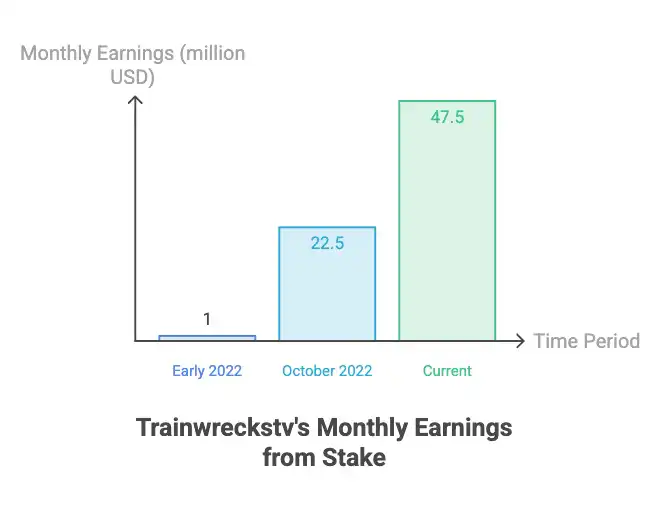
When his sponsorship with Stake first became public knowledge in early 2022, the figure attached to it was $1 million a month. Trainwrecks disputed that this represented his ongoing pay, telling his chat he was making “much more” and that the $1 million figure only applied to his first month under contract.
By October 2022, Train gave a running total: he said he had been paid $360 million over 16 months of streaming for Stake – an average of roughly $22.5 million a month at that stage of the contract.
More recently, Trainwreck put his current pay at roughly $500,000 an hour, working out to close to $50 million a month. Third-party tracking puts his estimated monthly payment at $45 million and his overall estimated market value at $344.8 million, based on a following of over 624,000 and lifetime average viewership near 27,000.
For scale, Trainwreck’s deal is an outlier even within gambling streaming – most Stake-sponsored creators are not publicly known to be paid anywhere near his rate, and his numbers are usually cited as the upper bound of what the industry pays.
What Does the Deal Actually Require?
Beyond the pay, the arrangement comes with specific obligations. Trainwreck’s own breakdown of his current contract ties the roughly $500,000-an-hour figure to a commitment of about 100 hours of streaming, meaning the pay is structured around time spent live on Stake rather than a flat monthly retainer.
He has no public affiliate code, unlike some gambling streamers who supplement sponsorship pay with affiliate revenue. He streams primarily on Kick, where he’s also a co-founder, meaning the platform hosting his Stake content and the casino paying him are two separate business relationships running side by side.
How Has the Deal Changed Over Time?
Laid out year by year, the pay trajectory looks like this:
- Early 2022: ~$1 million a month, in the first month of the contract
- October 2022: $360 million paid out over 16 months, averaging ~$22.5 million a month
- Current: ~$500,000 an hour, averaging $45-50 million a month by Trainwreck’s own account and third-party tracking
Comparing the earliest reported figure to the most recent one shows roughly a 47x increase – from $1 million in the first month of the deal to a current run-rate in the $45-50 million-a-month range.
Is the Stake Deal Profitable for Trainwreckstv?
It’s widely believed that Trainwreck plays at least partly with his own money rather than a fully sponsor-backstopped balance – meaning what happens on stream carries real financial stakes for him. That’s consistent with how he’s described the arrangement himself: mixing personal funds with what he’s given and gambling both together.
On the win side, the wins are real and large. Trainwreck has landed multiple eight-figure payouts on stream, including a $50 million hit on the slot Coins and Cauldrons and an earlier $37.5 million win on Hex Appeal – the kind of moments that go viral and fuel the perception that he’s coming out ahead.
But those headline wins don’t change the underlying math. Slots are built around a fixed return-to-player (RTP) rate that’s always below 100%, meaning the house holds a mathematical edge on every spin. Over a large enough volume of bets – and Trainwreck streams roughly 100 hours a month of high-stakes slot play – that edge guarantees the player loses more than they win in aggregate, regardless of how big any individual jackpot looks. In other words, on the gambling itself, Trainwreck is very likely running at a net loss over time, simply because that’s how the games are designed to work.
What makes the arrangement profitable for him anyway is the size of the sponsorship on top of it. At an estimated $45-50 million a month in Stake pay, the deal comfortably outweighs whatever he’s losing to house edge on the felt. The gambling and the sponsorship are two separate financial tracks: one is a game he’s structurally likely to lose over time, and the other is a business deal large enough to absorb those losses and still leave him highly profitable overall.
