- Official Website
- Are MYBC.game and BC.Game Same Casino?
- Licensing
- Games
- Bonuses And The VIP System
- Payments And Supported Currencies
- Withdrawals
- KYC And Identity Verification
- Restricted Countries
- VPN Policy
- Bonus Abuse Detection And Account Restrictions
- Responsible Gambling
- Trust and Security
- What Real Users Are Actually Saying
- Is MYBC.game a Scam?
MYBC.game is a crypto casino and sportsbook that launched in mid-2026. It’s run by a company called AceQueen Limited, licensed out of Anjouan, a small island jurisdiction that’s become popular with newer crypto casinos because licenses there are cheap and easy to get. We went through every official policy document line by line, tested the actual live site, and read through a month of real user reports on a public crypto forum. Here’s everything we found, laid out plainly.
Official Website
https://mybc.game/
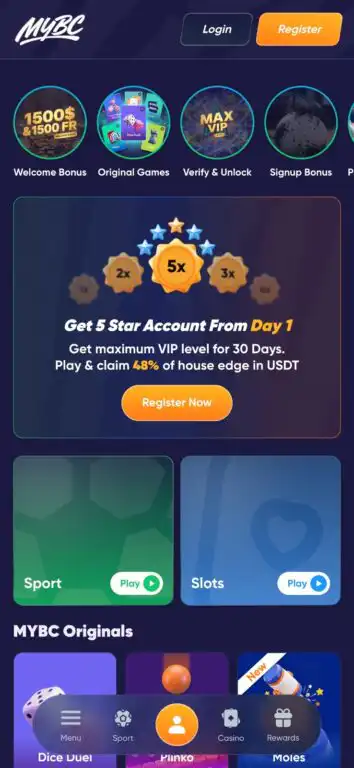
Registration is quick: email, an auto-generated username, a password, and an optional promo code. You can also sign up through Google or Telegram. There’s an 18+ checkbox tied to the Terms and Services.
At signup you also pick a welcome bonus: a $10 sports freebet, 50 free spins on a slot like Sweet Bonanza or Totally Hot, or 75 free rounds on the Originals games. You can also decline and take no bonus at all.
The site pushes a five-step “Welcome Journey” meant to unlock various rewards: verifying your identity, choosing your signup bonus, joining their Telegram channel, and verifying your phone number, each one unlocking a different reward (Telegram verification gets you $10, phone verification gets you 10 free spins). Looked at plainly, this is a structured funnel for collecting your email, phone number, and Telegram handle, each checkpoint dangling a small reward. That’s a common pattern across the industry, but it’s worth recognizing for what it is.
There’s also a referral program in the account dashboard, letting you link up with whoever referred you and track how many people you’ve referred.
Are MYBC.game and BC.Game Same Casino?
Let’s get this out of the way first because it comes up constantly. MYBC.game sounds a lot like BC.Game, a much bigger and more established crypto casino that has a pretty rough reputation online. On the operator’s own promotional thread on a crypto forum, at least half a dozen different users brought this up completely unprompted, some of them assuming it was a spinoff or rebrand.
The operator denies any connection and claims MYBC stands for “My Bonus City.” They also claimed to run “zero affiliate traffic,” which is a strange thing to say while actively running a promo code campaign with an ambassador handing out Bitcoin prizes for DMs.
Licensing
MYBC.game is licensed by the Anjouan Gaming Commission, license number ALSI-202604006-FI1, issued under the Computer Gaming Licensing Act 007 of 2005. We checked this against Anjouan’s public license registry and it does show up as valid.
That said, Anjouan is considered one of the weaker gambling licenses on the market. It’s not close to a Malta or UK-level license. It’s cheap, fast to get, and comes with light oversight. Plenty of legitimate small operators use it, but it also means the license alone doesn’t tell you much about how the site treats players day to day.
The company behind the site is AceQueen Limited, registered in the British Virgin Islands, with a listed address at Geneva Place, 2nd Floor, #333 Waterfront Drive, Road Town, Tortola. That’s a classic offshore corporate structure. On its own that’s not unusual for this industry, but it does mean that if something goes wrong, you’re not dealing with a company based somewhere with strong consumer protection laws.
Interestingly, the actual customer-facing emails from the company are signed off with a completely different address: “MYBC.Game Warehouse, West India Quay, London E14 4AL.” We looked that address up. It’s the real, current address of the Museum of London Docklands, a public museum in East London, not a business location of any kind. Whatever the explanation is, that’s not where anyone is running a casino from.
Official support channels are support@mybc.game for general questions and compliance@mybc.game specifically for complaints about KYC or AML checks on your account. There’s also a Telegram bot, @mybcprizeBot, pitched as a way to get “personalized bonuses.”
Games
To be fair, the game library is genuinely solid. You get slots, live casino tables, crash games, a sportsbook, and a set of in-house games called MYBC Originals: Dice Duel, Moles, Plinko, Mines, Limbo, Rock Paper Scissors, Tower, HiLo, and a blackjack variant called “Surrender.”
The slots come from a huge list of providers. Some are big, trusted names you’ll recognize, like Pragmatic Play, NetEnt, Hacksaw Gaming, Red Tiger, Spribe, Playson, Big Time Gaming, and Habanero. Mixed in with those are dozens of much smaller, less familiar studios, things like Charismatic, MacawGaming, TripleProfitsGames, and Espressogames. The marketing materials advertise “70+ world-class game studios,” which is plausible once you count all of them, though the promotional pages only ever show off the recognizable big names.
The live casino runs mostly on Evolution and Pragmatic Play Live, covering roulette, blackjack, baccarat, sic bo, and poker. That’s standard, reliable stuff you’d find at most decent casinos. There’s also a separate “Plane” category of Aviator-style crash games: Aviator, Aviatrix, High Flyer, and a few Aviamasters variants.
Bonuses And The VIP System
This is where things get complicated, and honestly, a little exhausting.
Beyond the welcome bonus, there’s a separate deposit bonus worth up to $1,500 in cash plus 1,500 free rounds, spread across your first three deposits. Each deposit gets a 100% cash match plus a 100% free-rounds match on Originals games.
On top of that sits a five-tier VIP system: One Star through Five Star. One Star is free with no wagering needed. Two Stars requires $50,000 wagered. Three Stars needs $100,000. Four Stars needs $250,000. Five Stars, the max, needs $500,000 wagered.
Your VIP tier multiplies five separate bonus mechanics at once: instant rakeback (paid out every 5 minutes), a reload bonus (three separate payouts every 8 hours), and daily, weekly, and monthly cashback. That’s five different recurring bonus streams stacked on top of each other, all scaled by your star level. In the live product, the base rakeback rate showed as 14%, daily cashback at 10%, weekly cashback at 7.5%, and monthly cashback at 5%. Real user testing on the forum found the actual rakeback in practice ranged anywhere from 7% to 21% depending on the game, and it wasn’t truly “instant” despite being marketed that way, you have to manually claim it every 5 minutes or lose it.
The fast track to Max VIP is completing identity verification, which grants you Five Star status immediately, but only for 30 days. The badge itself is labeled “30 Day Pass” and says you have to keep wagering to hold onto it after that. It’s a trial, not a permanent upgrade, even though the marketing language (“Get 5 Star Account From Day 1”) makes it sound more permanent than it is.
A few details stood out as sloppy or worse. The Daily, Weekly, and Monthly cashback pop-ups all use the exact same description text word for word, even though they’re supposed to be separate programs, someone copy-pasted the Daily Cashback description into the other two and never edited it. There’s also a “Claim Streak” feature that rewards you for logging in and claiming every single bonus without missing a day, resetting to zero the moment you skip one, the same kind of daily-engagement hook mobile games use, except here it’s tied to real-money gambling. And one power-up screen has a visible UI bug reading “Keep Increasing Your Tonus! To Get Bonus, Push Your Tonus!”, which isn’t an English word and reads like a mistranslation that made it to production without anyone catching it.
Wagering Requirements Are Genuinely Confusing
The default wagering requirement mentioned in the general FAQ is 10x, with bonuses expiring somewhere between 1 and 7 days, and supposedly no maximum cashout limit.
But the specific welcome deposit bonus terms buried in the Terms and Conditions say something more complicated: 20x wagering on slots, crash games, and casino games (where every $1 bet only counts as $0.30 toward the requirement), and a separate 8x wagering requirement specifically for sports betting, which only counts if every leg of your bet has odds of at least 1.30, or your total combined odds hit at least 2.20. Cashed-out bets and combo bets don’t count at all toward that sports requirement.
Real users also reported that a 100% deposit bonus with 10x wagering gets automatically applied to your deposit with no obvious way to opt out before you start playing. One tester reported that a wagering requirement from a bonus they’d already lost somehow carried over and attached itself to their next deposit, meaning money they thought was theirs got locked behind requirements they never agreed to in the first place. The operator acknowledged the auto-applied bonus issue as a real problem and said they passed it to their product team, but as of this writing it hadn’t been fixed.
If you’re the type of player who reads wagering terms closely before playing, you’ll have a hard time here. The numbers genuinely differ depending on which page, document, or person you ask.
There’s A Cap On How Much You Can Actually Win
Buried in the rules of play, there’s a maximum payout limit of €50,000 per game cycle on games that use a random number generator, meaning slots and similar titles. That includes the value of any bonus features like free spin rounds. Anything you win above that gets voided. It’s a fairly standard practice at some casinos, but it’s worth knowing about before you bet big on a slot with a huge jackpot multiplier advertised, because you might not actually get to keep all of it.
Payments And Supported Currencies
Here’s a clean, checkable factual gap. The official FAQ lists exactly five supported cryptocurrencies: USDT, BTC, ETH, LTC, and TRX.
That’s simply out of date. When we opened the actual wallet in the live product, we counted 14 different assets, including USDC, Dogecoin, Ripple, BNB, Solana, POL, and Bitcoin Cash, on top of the five listed in the FAQ. On top of that, the wallet also shows fiat balances explicitly labeled USD and EUR, something not mentioned anywhere in the FAQ, AML policy, or Terms and Conditions, despite the platform describing itself as strictly “crypto-based.”
The minimum deposit is 1 USDT, which is low and reasonable. One forum user who deposited BTC confirmed it was correctly credited to their BTC balance rather than auto-converted, which is a small point in the site’s favor. Another user did note the withdrawal form was confusingly labeled, appearing to ask for an amount in USD when it actually expected the figure in BTC, though clicking “max” filled in the right number automatically, so it’s more of a UX annoyance than a real problem.
Withdrawals
This is where the official documentation and the real world stop lining up.
The FAQ says the minimum withdrawal is 10 USDT and claims withdrawals process within 15 minutes. The Terms and Conditions say the minimum is €10 instead. But in the operator’s own promotional forum thread, both the company’s representative and multiple real users independently confirmed the actual minimum withdrawal is $50, five times higher than what either official document states. One user even directly told the operator’s rep, in the thread, that their FAQ page still says $10 and needs updating. As far as we can tell, it never was.
Real withdrawal times reported by actual users ranged from about 3 to 6 hours, not the 15 minutes advertised. That’s not unreasonable by industry standards, but it’s a meaningful gap between the marketing claim and reality.
Multiple users also reported a mandatory “liveness check,” essentially a selfie or video verification step, required for withdrawals. This isn’t mentioned in any of the official policy documents. One user went through this verification step on their first withdrawal but not on their second, suggesting the process isn’t applied consistently.
There’s also a visual bug on the withdrawal page that multiple independent users reported: it displays your crypto balance as “0.00” even when you actually have funds, apparently because it’s only showing two decimal places on a balance with more precision than that. More than one person said this genuinely scared them for a moment before they realized their money was still there.
On withdrawal caps: if your balance looks unusually large relative to what you’ve deposited, you’re capped at €5,000 per month; otherwise the cap is €10,000 per month. If you don’t wager your deposit at least once before withdrawing, you’ll be charged an 8% fee with a €4 minimum, framed as an anti-money-laundering measure. Winnings from no-deposit bonuses specifically are capped between $50 and $200 regardless of how much you actually won.
KYC And Identity Verification
According to the FAQ, you don’t need to verify your identity to sign up or start playing. Verification only becomes mandatory if you try to withdraw over $2,000, your weekly turnover exceeds $100,000, or something trips a fraud or risk alert.
The actual AML policy tells a more complicated story. It describes a three-step verification system:
- Step one is a basic form (name, date of birth, country, address) required before any withdrawal at all, no threshold needed, and this basic document is apparently drafted and saved by an AI system, with a human employee only stepping in for additional checks if something looks off.
- Step two, requiring a photo ID and a selfie with a handwritten six-digit code, kicks in at any withdrawal or any deposit over $2,000, for players in what the policy calls “low risk” regions.
- Step three, which requires you to document your actual source of wealth (things like employment, business ownership, or inheritance), kicks in at $5,000 in deposits or withdrawals, or $3,000 in tips to another user.
If you’re from a region the operator classifies as “medium risk,” those thresholds drop dramatically: step two triggers at just $1,000 in deposits or withdrawals, or $500 in tips. Step three triggers at $2,500, or $1,000 in tips. Players from “high risk” regions are banned outright. There’s also an odd wrinkle buried in the policy: even if you’re from a “low risk” region, the moment you convert your crypto into a different currency, you get treated as if you were medium risk for verification purposes, meaning your thresholds drop too. None of this appears in the FAQ, which makes verification sound like something that only affects big spenders.
The AML policy also describes ongoing behind-the-scenes monitoring beyond just identity checks: an AI system flags unusual account behavior for staff to review, and a “data scientist” reportedly watches for patterns like depositing and withdrawing without actually playing, switching between different bank accounts, or sudden changes in nationality or currency use. The company says it keeps identification and transaction records on file for at least ten years after your relationship with them ends, and claims to reassess its overall risk framework annually. All of this is standard-sounding compliance language, but it’s also a reminder that there’s a fair amount of automated and manual surveillance happening on your account activity in the background, most of which you’ll never see or be told about directly.
Then there’s what happened on the operator’s own promotional forum thread, which is genuinely one of the more concerning things we found. The company’s representative repeatedly and publicly offered to waive KYC entirely for members of that specific forum with enough reputation, in exchange for a private message with their username. Over the course of the thread, the stated policy shifted multiple times, first “no KYC for any reason,” then “no KYC unless we suspect fraud,” then a vague “$50,000 platform-wide daily limit,” and eventually back to normal KYC applying to anyone without forum credentials. A licensed gambling platform selectively skipping its own compliance process for a subset of users, based purely on where they happened to hear about the site, is not how identity verification and anti-money-laundering rules are supposed to work.
Multiple users also reported getting emails confirming their KYC was approved, only to be asked to verify again days later. The operator called this a bug introduced by a rushed “hotfix.” That may well be true, but repeated, inconsistent verification status is exactly the kind of thing that turns into a real problem the moment you’re trying to withdraw money and the system doesn’t recognize you as verified. One tester described the actual KYC flow as clunky in practice: their documents were rejected on the first pass, and only went through after a second verification step ran through a third-party provider called Sumsub. A different user, a resident of the Netherlands, had their documents rejected outright and couldn’t get verified at all, consistent with the Netherlands being on the platform’s restricted country list.
Restricted Countries
The Terms and Conditions block players from Australia, Austria, France and its territories, Germany, the Netherlands and its territories, Spain, Comoros, the UK, the USA and its territories, and any FATF-blacklisted country.
Oddly, the separate KYC Policy document lists almost the same countries but leaves Australia off entirely. Two official documents from the same company, describing the same restriction, that don’t actually match. And none of this list appears anywhere in the general FAQ at all, which is the page most people are actually going to read before deciding whether to sign up. If you relied on the FAQ alone, you’d have no idea some of the biggest gambling markets in Europe, plus Australia, are excluded.
We saw at least one real-world case of this being enforced: the Dutch user mentioned above whose KYC was rejected, consistent with the Netherlands restriction actually applying in practice, even if it’s badly communicated.
VPN Policy
This one is a straightforward contradiction between two official documents. The FAQ says using a VPN “is not forbidden,” though it might get your bonuses restricted or trigger extra verification. The Terms and Conditions say the opposite in black and white: you “may not use a VPN, proxy or similar services… that mask or manipulate the identification of your real location.”
One document treats it as a soft inconvenience, the other treats it as a violation of your obligations under the contract. That’s not a small wording difference, it’s two different rules. Which one the operator actually enforces in practice seems to depend on which one benefits them at the time.
Bonus Abuse Detection And Account Restrictions
The Terms and Conditions include a fairly aggressive section about what they call “Account Integrity” and “Promotional Play.” It bans the usual things you’d expect, running multiple accounts, colluding with other players, using bots or automation. But it goes further than most casinos we’ve seen, explicitly listing things like using deposited funds and bonus funds “in materially different ways,” selecting specific games or stake sizes primarily to grind out turnover, or repeatedly claiming promotions and withdrawing shortly after as reasons your account can be restricted.
The company says it assesses this using a mix of your deposit and withdrawal patterns, stake sizes, game selection, and account history, and says a single ordinary action on its own, like using cash out or requesting a withdrawal, won’t be treated as a violation. That’s meant to be reassuring, but the criteria as written are vague enough that fairly normal play patterns (using cash out a lot, playing conservatively, requesting a withdrawal soon after finishing a bonus) could plausibly get flagged if the system, or a human reviewing it, decides your overall pattern looks like bonus abuse. The consequences range from losing eligibility for future promotions all the way up to having your account suspended and any bonus winnings confiscated. If you plan on using any of the bonuses on this site, it’s worth knowing that fairly ordinary playing habits could put you under this kind of scrutiny.
Responsible Gambling
To their credit, MYBC.game does have a real responsible gambling page. It includes a short self-assessment checklist (questions like whether gambling has caused arguments with family or friends, or whether you find it hard to stop), and links out to Gamblers Anonymous, Gambling Therapy, and GamCare. There’s a genuine self-exclusion option lasting a minimum of 6 months, with no promotional material sent during that time, plus a shorter 7-day cooling-off period if you just need a break. The FAQ also mentions a 24-hour “panic freeze” option, letting you lock your account for a single day if you need an immediate pause, though this feature isn’t explained anywhere on the dedicated Responsible Gambling page itself, only mentioned briefly in the FAQ. There’s also guidance for parents on keeping devices and accounts secured from kids.
Trust and Security
A handful of smaller issues add up to a bigger picture worth taking seriously.
The Terms and Conditions and AML Policy, the actual legal documents governing your rights, your money, and the company’s liability toward you, are riddled with garbled, broken sentences and missing words throughout, not the occasional typo, but sentence fragments, including inside the sections covering liability limits and withdrawal fees. The AML Policy also cites Belgian law and EU directives despite the operator being a British Virgin Islands company licensed in Anjouan, which suggests the document may be a lightly-edited template rather than something written specifically for this business.
Elsewhere, the main marketing headline in the operator’s own promotional materials misspells “Journey” as “Jorney.” The cashback bonus pop-ups are copy-pasted without proper editing. There’s a UI bug showing nonsense text (“Tonus”) in a bonus screen. None of these are individually dramatic, but together they paint a picture of an operation that either doesn’t have the resources for basic quality control, or doesn’t prioritize it, on both its legal contracts and its customer-facing product.
When one user reported two legitimate security bugs through live chat, the first was rewarded with 100 free spins, described by the operator as worth about $150. The second, apparently more serious, bug was rewarded with a dice bonus carrying a 40x wagering requirement, and support initially told the user a cash bounty would be paid directly to their wallet, only for a different support agent to later deny knowing anything about it. The operator eventually confirmed on the public forum that no formal bug bounty program has ever existed.
What Real Users Are Actually Saying
Beyond the official policies and the live product, there’s a public thread on a large crypto forum where the operator’s own representative has been actively promoting MYBC.game and fielding questions from real users for over a month. It’s genuinely useful reading precisely because it’s adversarial and independently timestamped, not marketing copy.
Some of what we found there has already come up above: the $50 real minimum withdrawal, the liveness check, the KYC-bypass-for-forum-members offer that kept changing its own rules, the auto-applied bonus with no opt-out, and the balance display bug.
On the positive side, actual users did report successful withdrawals, including one for $250 and another for $85, both processed within a matter of hours, and multiple users made it through the full deposit-to-withdrawal cycle without losing money to the platform itself. One user’s informal fairness test across 5,000-plus spins on Limbo and Dice also came back looking reasonably even. So people are getting paid, and the games seem to run fairly on the surface. That’s worth acknowledging. It’s just not the same thing as the platform being transparent or well-run.
Is MYBC.game a Scam?
MYBC.game has a real, independently checkable gambling license, and a genuinely decent game library that includes plenty of titles from trusted, independently audited providers. That’s more than plenty of outright scam sites can claim, and real users have gone through full deposit-to-withdrawal cycles and gotten paid, with at least one informal fairness test suggesting the core games run straight.
But almost everything else here raises real questions. The official FAQ contradicts the Terms and Conditions on withdrawal minimums, restricted countries, and VPN rules. The two documents governing exactly which countries are banned don’t even agree with each other. The real-world minimum withdrawal is five times higher than what’s advertised, and it took a user pointing this out publicly for the operator to even acknowledge it, without ever fixing it. KYC policy is applied inconsistently and was openly offered as something to bypass for a specific promotional audience, which is a serious thing for a licensed financial platform to do. Wagering requirements differ depending on which document or person you ask, there’s a vaguely-defined bonus abuse policy that could flag fairly normal play, and a €50,000 payout cap on RNG games that isn’t mentioned anywhere in the marketing. The legal documents that govern your money are full of broken sentences serious enough to make you wonder if anyone proofread the contract you’re agreeing to. The company’s own customer-facing correspondence traces back to a public museum in London.
None of this proves MYBC.game is an outright scam, and we’re not calling it one. But “some people successfully withdrew their money” is a fairly low bar for a real-money gambling platform, and it’s not the same thing as being trustworthy or well-run.
If you do decide to use this site, go in with money you’re fully prepared to lose, keep your first deposits small while you test how withdrawals actually work for you, verify the current terms directly in the product rather than trusting the FAQ, and don’t count on the wagering requirements, payout caps, or bonus rules matching whatever the page in front of you says. There are more established, more transparent, and more consistent operators out there if you’d rather avoid the guesswork.