Disco Balls by Evolution looks like a simple number-draw game, but there’s a full multiplier engine underneath that most players never learn to read. This guide covers how the multiplier layers stack, how many numbers to bet each round, and which bets to avoid.
Before You Play
You need to understand multiplier layers before anything else in this guide clicks.
Think of each round like a pot that keeps boiling. Four ingredients go in:
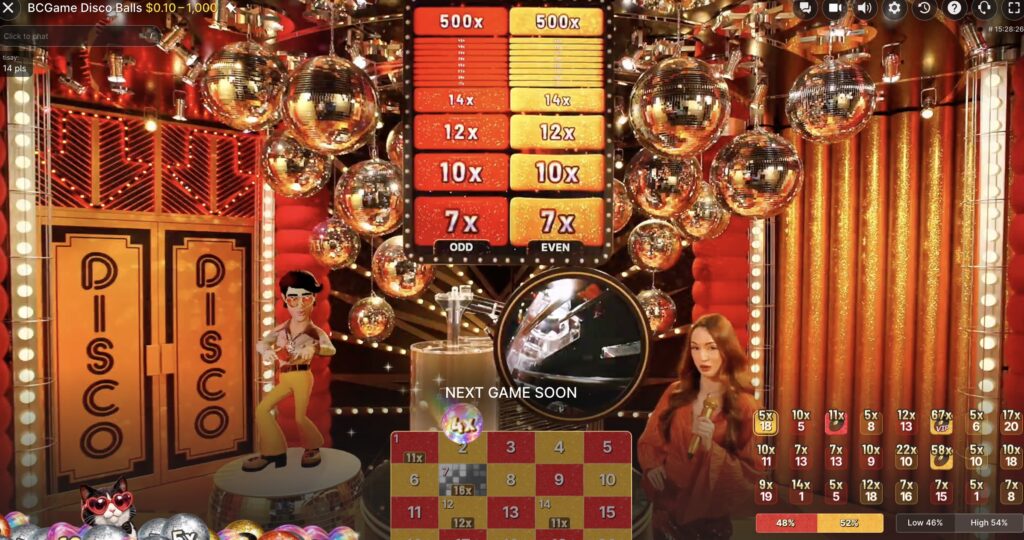
- Cat multipliers (3x-20x) land before the draw. Free boost on random numbers.
- Ball multipliers (3x-10x) stack higher every time a Step ball drops. They compound.
- Ladder multipliers (5x-500x) climb alongside them. Red ladder for odd numbers, gold for even. Often the biggest chunk of your final payout.
- Bonus game (up to 10,000x) triggers if the Result ball hits the Bonus number. Everything you’ve built carries over.
Longer rounds build all of these at once. Every strategy tip below comes back to that.
How Many Numbers to Cover
Three to five. Here’s why.
One number gives you a 5% hit rate. You’ll sit through 20-round dry spells watching ladders climb to 75x on somebody else’s number. That gets old fast.
Ten or more numbers and you’re hitting constantly, but each win is so diluted it barely feels like anything – even on rounds where the multipliers went crazy.
Three to five gets you connecting roughly every 3–5 rounds, which is enough to catch the deep-draw rounds where everything’s been stacking. And each number still has enough behind it that wins actually land.
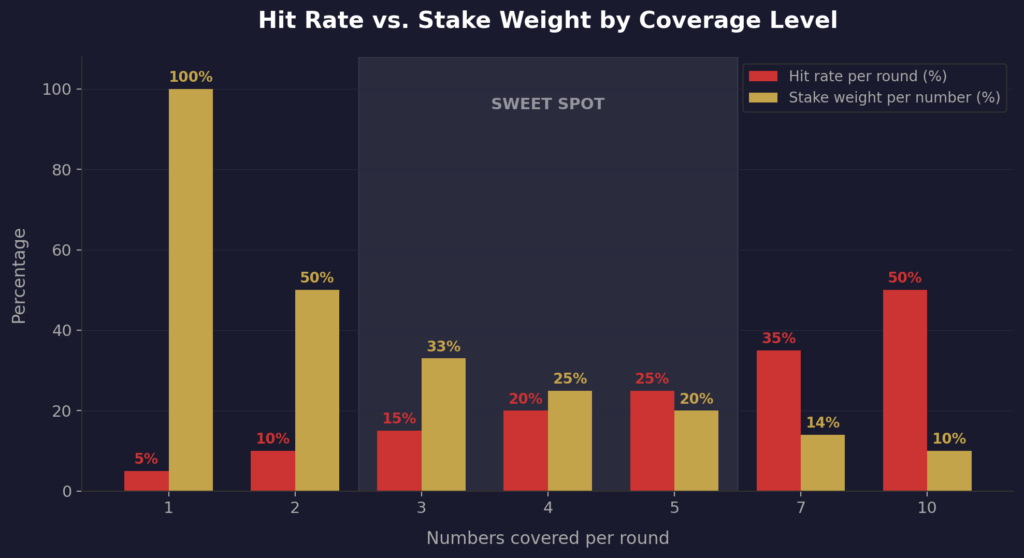
There’s a bonus angle too. Disco Cat marks one number per round with a Bonus symbol, and you don’t see which one until after betting closes. Five numbers gives you a 25% shot at holding that Bonus number. One number gives you 5%. Over a full session, that difference in Bonus game exposure is the difference between getting in and never getting in.
Group Bets Pay Worst When It Matters Most
The lower RTP on group bets in Disco Balls is common knowledge. But there’s a structural disadvantage that goes beyond the numbers. Group bets don’t receive Cat or Ball multipliers – those only land on individual numbers.
In a deep-draw round where the grid is loaded with stacked multipliers, a group bet pays you the ladder value and nothing else. A numbered bet on the same winning number pays ladder + Cat + Ball. On a round with a 50x ladder and a number carrying 30x in Cat and Ball multipliers, that’s the difference between 50x and 80x. The gap gets wider exactly when it matters most – on the high-value rounds that drive your session returns.
Return Profile
Most rounds end with 2-4 Step balls. The ladder sits in the 7x-20x range. Cat and Ball multipliers add maybe another 10x-30x on a lucky number. So your typical winning payout lands somewhere between 15x-50x. Nothing life-changing. The distribution is heavily right-skewed – a handful of deep-draw rounds and rare Bonus entries account for a disproportionate chunk of total returns.
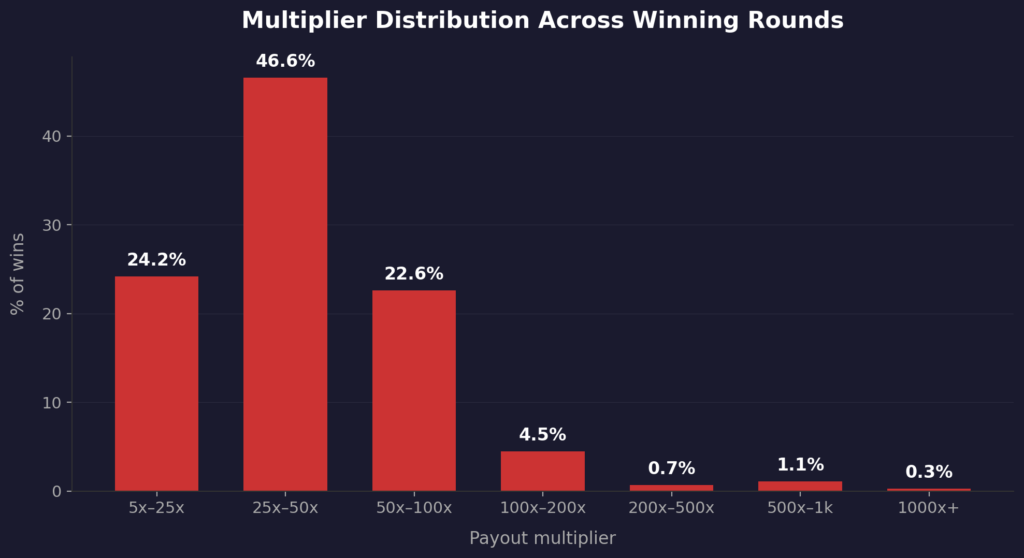
This means your session strategy should be designed to survive the flat middle and stay in the game for the spikes. Covering 3-5 numbers is partly about hit rate, but it’s really about longevity. You’re buying rounds at the table, and the more rounds you see, the more likely you catch a 6+ Step ball round or a Bonus entry.
How the Ladder Acceleration Works
The ladder progression isn’t linear. Early steps add 2x-3x each. But from 75x onwards, you’re jumping 25x, then 50x, then 375x in a single step (125x → 500x). This means 80% of the ladder’s value is concentrated in the last three steps. A round with 5 Step balls (ladder around 20x-30x) is good. A round with 7 Step balls (ladder around 75x-125x) isn’t just a bit better – it’s 3x–5x more valuable from the ladder alone, before you even count the extra Ball multiplier stacks.
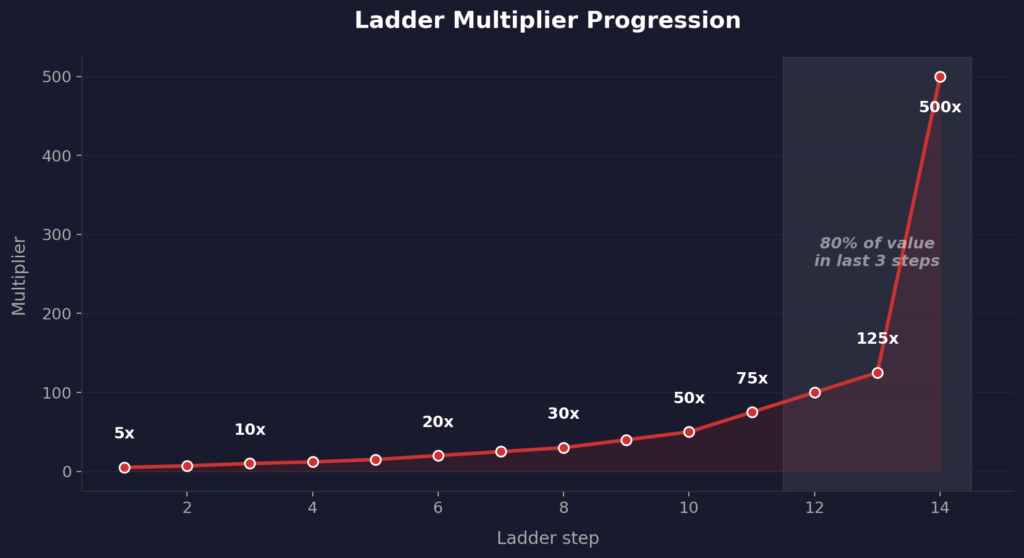
The strategy takeaway: don’t mentally check out on a round that’s already at 30x. The next two Step balls could triple or quadruple the ladder’s contribution.
How to Structure a Session
Start with a round budget, not a per-number budget. Decide what you’re spending, then split it across 25-50 rounds. Equal weight is fine – there’s no information advantage that makes one number better than another before the Cat phase, and you won’t see the Cat’s multiplier placement until after betting closes.
If your session bankroll is $200 and you want 40+ rounds, that’s $5 per round. Spread across four numbers, that’s $1.25 each. Not glamorous, but you’re connecting every 4-5 rounds on average, you’ve got a 20% shot at holding the Bonus number each round, and each win carries enough weight that a 50x hit on a single number returns $62.50 – not bad for a $5 round.
Flat bet every round. The distribution in this game is right-skewed, which means your results over any short session are dominated by whether you happened to catch a deep-draw round or a Bonus entry. Doubling up after losses doesn’t improve your odds of catching one – it just makes the dry spells more expensive.
What Not to Do
Don’t cover 10+ numbers thinking you’re being safe. You’ll hit constantly and feel like you’re winning, but the wins are so thin that the house edge grinds you down faster than you’d expect. High hit rate with low payout weight is the worst combination in a game built around rare spikes.
Don’t mix group bets with numbered bets expecting them to complement each other. They’re exposed to fundamentally different multiplier layers. A group bet on Odd sitting next to a numbered bet on 7 doesn’t give you “double coverage” on 7 – it gives you two bets with different payout structures on the same outcome. If 7 hits on a loaded round, your numbered bet collects everything while your Odd bet collects only the ladder. You’re paying for two bets but only one of them captures the full value.
Don’t chase the Bonus. It’s roughly a 1-in-20 trigger each round, and you need to be holding the right number. Over 40 rounds with 4 numbers covered, you’ve got roughly an 87% chance of holding a Bonus number at least once – but it still has to be drawn as the Result ball.
Play Smart
Three things to take away from this guide:
- Numbered bets only. Group bets cut you off from two multiplier layers and cost you most on the rounds that matter most.
- Cover 3-5 numbers. It’s not just about hit rate – it’s about staying in the game long enough to catch deep draws and Bonus entries.
- Budget for 40+ rounds. Disco Balls rewards patience. Short sessions are coin flips. Longer sessions let the return profile work in your favour.
Disco Balls isn’t a game where you pick lucky numbers and hope for the best. It’s a game where you position yourself correctly, stay at the table, and let the multiplier engine do what it’s designed to do. The players who understand that will consistently get more out of it than the ones who don’t.